How Long Does It Take to Prepare for IELTS?

How Long Does It Take to Prepare for IELTS?

A student aiming for Band 7 does not need the same preparation time as someone starting with basic English and targeting Band 6. That is the real answer to how long does it take to prepare for IELTS – it depends on your current level, your target score, and how consistently you study. Some candidates are ready in a few weeks. Others need several months of guided practice to build both language ability and exam technique.

If your IELTS score matters for university admission, visa processing, professional registration or migration plans, guessing is risky. A realistic preparation timeline helps you avoid two common mistakes: booking the test too early and wasting money, or delaying too long and losing momentum.

How long does it take to prepare for IELTS realistically?

For most students, a sensible preparation window falls between 4 weeks and 6 months. That range sounds wide because IELTS is not a simple memory-based exam. It tests reading, writing, listening and speaking under pressure, and each skill develops at a different speed.

If your English is already strong and you use it regularly for study or work, you may only need 3 to 6 weeks of focused preparation. In that case, the main job is learning the test format, improving time management, and correcting small but costly mistakes in writing and speaking.

If your English is moderate but uneven, 2 to 3 months is more realistic. Many students in this group can understand English reasonably well but struggle with academic writing, complex reading passages, or speaking with confidence. They need both skill improvement and exam strategy.

If you are a beginner or you have been away from English for a long time, 4 to 6 months is often the better timeline. Trying to rush IELTS when your foundation is weak usually leads to frustration. A longer plan gives you time to improve grammar, vocabulary, pronunciation and fluency before moving into full exam practice.

What affects how long it takes to prepare for IELTS?

Your starting point matters more than almost anything else. A student who is already near Band 6.5 may only need structured corrections to reach Band 7. Another student at Band 4.5 may need months of language-building before that same score becomes realistic.

Your target band score also changes the timeline. Moving from Band 5.5 to Band 6 is usually easier than moving from Band 6.5 to Band 7.5. Higher bands demand better accuracy, stronger vocabulary control and fewer repeated errors. At that level, small weaknesses become more visible.

Study intensity makes a big difference too. A learner studying 90 minutes every day will usually progress faster than someone studying only on weekends. Consistency matters more than occasional long sessions. IELTS rewards regular exposure to English and repeated timed practice.

The final factor is the quality of preparation. Many students spend months studying without real improvement because they practise without feedback. They repeat the same writing mistakes, misunderstand speaking criteria, or do listening exercises without analysing errors. Expert guidance often shortens the journey because it replaces random effort with a structured plan.

Preparation timelines by student type

If your English is already good

If you regularly watch, read, write or speak in English, and you can already communicate with reasonable confidence, you may be ready in about 1 month. This is especially true if your target is Band 6.5 or 7.

At this stage, preparation should focus on test-specific skills. You need to understand the question types, practise under timed conditions, improve essay structure, and learn how speaking is assessed. Strong English alone does not guarantee a strong IELTS result. Many capable students lose marks because they answer off-topic in Writing Task 2, write weak overviews in Task 1, or speak too briefly in the interview.

If your English is average

This is where many candidates fall. You can follow lectures, read familiar texts and hold everyday conversations, but your grammar is inconsistent and your confidence drops under exam pressure. For this group, 8 to 12 weeks is often ideal.

This timeline gives enough room to work on all four skills without rushing. You can improve academic vocabulary, develop essay planning habits, learn how to skim reading passages efficiently and build fluency for the speaking test. It also gives time for mock tests and score tracking.

If your English needs foundation work

If you struggle to understand normal spoken English, make frequent grammar errors, or find it difficult to write even simple paragraphs, a crash course is unlikely to be enough. A 4 to 6 month plan is more realistic.

That does not mean your goal is out of reach. It simply means the first stage should build your foundation. Once your core English improves, IELTS strategies become far more effective. Students who accept this often make stronger long-term progress than those who rush straight into full mock tests.

How many hours should you study each week?

There is no perfect number for everyone, but a practical target is 8 to 12 hours a week for steady progress. If your deadline is close, you may need 15 hours or more. What matters is whether those hours are structured.

A good weekly plan includes all four skills, not just the areas you enjoy. Many students over-practise reading and listening because they are easier to do alone, while avoiding writing and speaking because those feel harder. Unfortunately, that creates an unbalanced score profile.

A useful routine might include weekday study sessions for reading, listening and vocabulary, then dedicated time for writing practice, speaking drills and one timed section at the weekend. If you are working or studying full-time, even 60 to 90 focused minutes a day can produce strong improvement over time.

Signs you are ready to book the test

You do not need to feel perfect before booking IELTS, but you should see clear signs of readiness. Your mock test scores should be close to your target band, not far below it. Your writing should show better organisation and fewer repeated grammar mistakes. In speaking, you should be able to answer without freezing after every question.

Another good sign is score consistency. One strong mock result is encouraging, but two or three stable performances are more reliable. If your listening score swings wildly, or your writing stays much lower than your other sections, more preparation may save you from disappointment.

This is why guided mock testing matters. It helps you measure progress honestly instead of relying on guesswork.

Can you prepare for IELTS in one month?

Yes, but only in the right situation. One month can work well if you already have a decent command of English and need targeted exam preparation. It can also work if you previously took IELTS and already understand the format.

For beginners, one month is usually too short for major band improvement. You may become more familiar with the test, but familiarity alone will not fix weak grammar, limited vocabulary or hesitant speaking. Short timelines are useful when the foundation is already there. They are much less effective when the foundation still needs building.

The fastest way to improve without wasting time

The quickest route is not studying harder at random. It is studying with direction. Start with a level check or mock test so you know your real position. Then set a target band and work backwards from your deadline.

From there, focus on the areas that most affect your score. For many students, writing and speaking produce the biggest gains when corrected properly. Reading and listening often improve through repeated practice and error analysis, but writing and speaking usually need personal feedback.

A structured IELTS course can also speed things up because it gives you a timetable, expert correction and accountability. That is especially helpful if you are balancing IELTS with university, work or visa deadlines. At NextStep, students benefit most when they join the right batch for their level rather than forcing themselves into a one-size-fits-all schedule.

A realistic way to plan your IELTS journey

If your test date is flexible, give yourself enough time to improve with confidence instead of panic. A strong IELTS score is rarely the result of last-minute effort. It comes from accurate assessment, consistent practice and expert support where needed.

So, how long does it take to prepare for IELTS? Long enough to close the gap between where you are now and the score your future plans require. If you treat that gap honestly and prepare with structure, your timeline becomes clearer – and your result becomes far more achievable.

Choose a plan that matches your level, not your wishful deadline. That is how real progress starts.

Can You Score a IELTS Band 7 with Weak Grammar? (Honest Answer + Real Solution)

Can You Score a IELTS Band 7 with Weak Grammar? (Honest Answer + Real Solution)

🟢 Can You Score a IELTS Band 7 with Weak Grammar? (Honest Answer + Real Solution)

If you’ve been preparing for IELTS in Bangladesh, you’ve probably asked yourself this at some point:
👉 “Can I still get a Band 7… even if my grammar isn’t strong?”

Let’s be honest — this is one of the biggest fears students have. You memorise vocabulary, watch YouTube tips, and practise daily, but when it comes to writing or speaking, something doesn’t feel right. And deep down, you know why.


 The Real Problem: Grammar Fear in Bangladesh

Most students here don’t lack effort; they lack clarity in grammar fundamentals. You might relate to this:

  • You know good vocabulary… but your sentences feel “broken”
  • You’re unsure about tenses when writing essays
  • Subject-verb agreement still confuses you
  • You translate from Bengali to English in your head
Can You Score a IELTS Band 7 with Weak Grammar? (Honest Answer + Real Solution)

Stuck at Band 5.5?

Next Batch: 2026 Registration Open
Zero-Level Grammar Prep
Fix Bengali to English Errors
4 Months Complete Training
Maximum 15 Students
View Foundation Course 💬 Free Level Assessment *Save your 25,000 BDT Exam Fee!
❌ The Biggest Myth: “I need to be perfect at grammar to get Band 7.”
This is NOT true.
✅ The Reality (What IELTS Actually Measures):
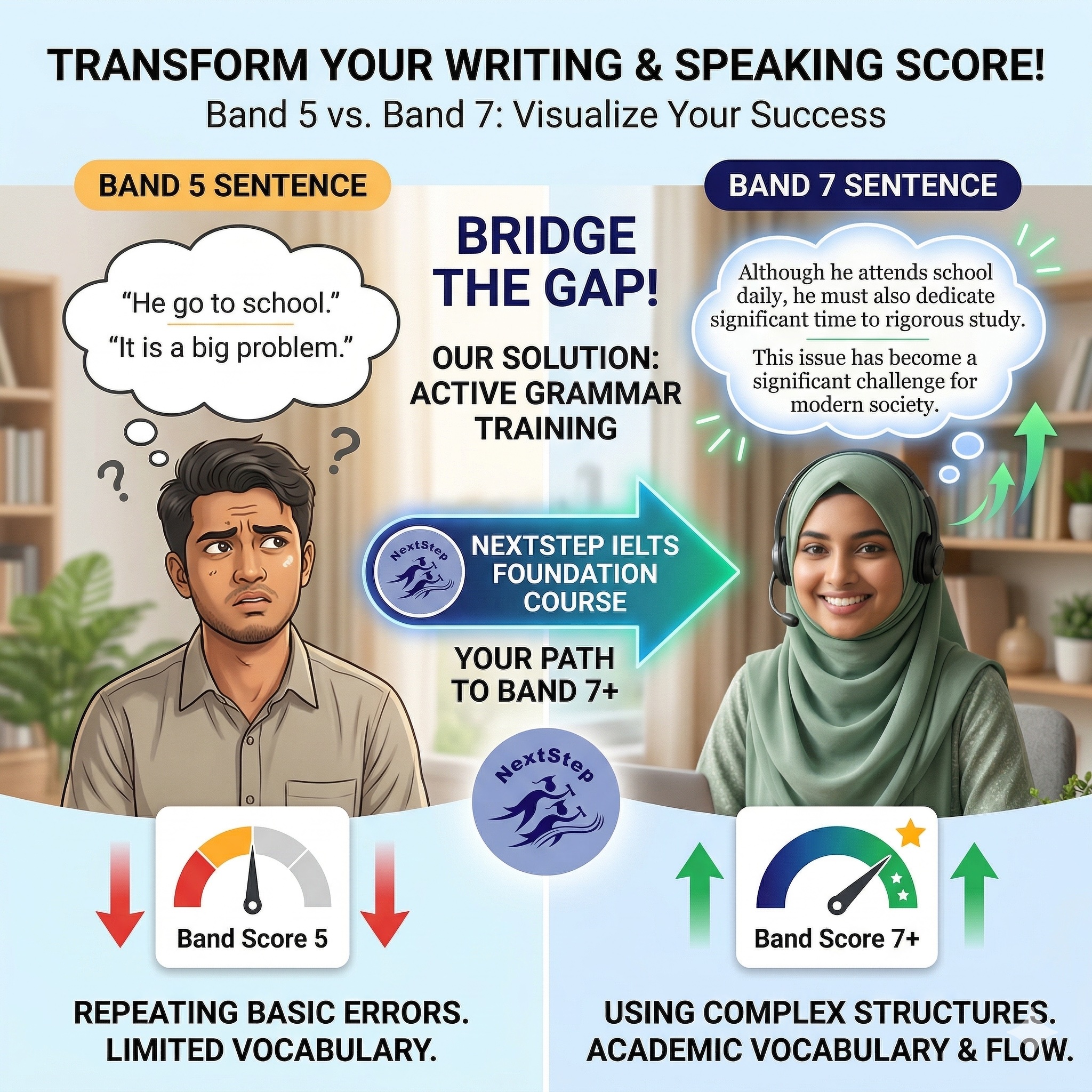
IELTS is not a grammar exam. But grammar still counts for 25% of your score in Writing and Speaking. You don't need perfection, but you need controlled, accurate grammar.

🎯 Can You Get Band 7 with Weak Grammar?

Short answer: No — but you don’t need perfect grammar either.

🧠 The “Threshold” Most Students Don’t Understand

You can make small mistakes. That’s fine. But if you repeat the same error, use only simple sentences, or avoid complex structures, you’ll be stuck at Band 5.5–6.0 forever.

📌 What Band 7 Actually Requires

  • Use a mix of simple + complex sentences
  • Show control over tenses
  • Make fewer repeated mistakes

📚 Why Self-Study Grammar Doesn’t Work

Many students try watching YouTube or reading books like Murphy. But that’s passive learning. IELTS needs active grammar. Can you use conditionals in an essay? Can you speak using correct tenses naturally? Most students can't—and that’s why scores don’t improve.

🚀 How Our IELTS Foundation Course Fixes This

Instead of jumping straight into exam tricks, we fix your core English first through our IELTS with Foundation Course Bangladesh.

01 Phase 1: Diagnosis

Every student is different. We identify your specific grammar gaps, sentence structure issues, and speaking weaknesses.

02 Phase 2: Build the Core (The “Big 4”)

  • Tenses & Sentence Control: Stop guessing and start writing confidently.
  • Complex & Compound Sentences: Essential for Band 7+ writing.
  • Punctuation That Boosts Score: Yes — even commas and semicolons matter.
  • Fixing “Bangladeshi English”: Stop translating directly from Bengali.

03 Phase 3: Apply It to IELTS

Once your basics are strong, we move to Writing Task 1 & 2 and Speaking practice. Now the “tips & tricks” actually work.

⏳ Course Structure (What You Get)

This is a complete transformation programme, not a quick fix.

  • 📅 Duration: 4 months
  • 👥 Small batches: Max 15 students
  • 📝 Mock Tests: 7 full tests
  • 📚 Materials: Foundation + IELTS materials included
  • ✍️ Feedback: Personal feedback on writing & speaking
“I was stuck at Band 5.5 for years. I knew vocabulary, but my grammar held me back. After joining the Foundation course, I fixed my basics and finally achieved Band 7.5.”

⚠️ The IELTS exam costs over 25,000 BDT. Don’t waste money by taking it unprepared.

🚀 Ready to Fix Your Basics?

Book a free level assessment and talk to us honestly — no pressure.

💬 WhatsApp: +8801946 004411

Frequently Asked Questions

Strictly speaking, no. "Grammatical Range and Accuracy" makes up 25% of your score. However, you don't need to be a linguist; you just need to master specific complex structures and reduce repeated errors.
For most students in Bangladesh, a 2-month foundation period followed by 2 months of intensive IELTS training (4 months total) is the most effective timeline to see a 1.5 to 2.0 band score improvement.
No, both follow the same global assessment criteria. The marking for grammar is standardized worldwide, so your focus should be on accuracy rather than the test center.
Yes, NextStep offers fully interactive live online batches for the Foundation course, specifically designed for students who cannot travel to our Dhaka office.
IELTS Writing Task 2 Best Templates

IELTS Writing Task 2 Best Templates

IELTS Writing Task 2 Best Templates

IELTS Essay Writing Templates

IELTS Writing Task 2 Best Templates

IELTS Writing Task 2 Best Templates

IELTS Essay Writing Template for a Statement Type Question:


Introduction:

The discourse surrounding [Topic] has become increasingly contentious, with divergent viewpoints emerging regarding its perceived benefits or drawbacks. This dynamic has fueled a robust debate in recent years. In my estimation, the proposition that _______ appears to be more cogent. This essay will delineate my rationale for endorsing the affirmative/negative stance and ultimately arrive at a reasoned conclusion.

Body paragraph 1 :

Delving into the statement’s intricacies, a pivotal rationale behind this assertion is _______. Furthermore, an additional advantage lies in _______. It is undeniable that the primary impetus behind this phenomenon is _______.

Body paragraph 2 :

Digging deeper, a fundamental underpinning of this perspective stems from _______. Furthermore, it is pertinent to underscore that _______. Moreover, _______.

Conclusion:

In conclusion, the multifaceted benefits/drawbacks of _______ cannot be overlooked. The arguments outlined above lend credence to the assertion that the advantages/disadvantages of _______ are indeed significant.

2. Essay Writing Template for Agree/Disagree Type of Question:


Introduction:

In an era characterized by _______ (rephrase the statement), the assertion that _______ has sparked considerable discussion. _______ (provide one explanatory line). In my perspective, I wholeheartedly concur/disagree with this notion, a viewpoint that will be expounded upon in subsequent paragraphs, culminating in a coherent conclusion.

Body paragraph 1 :

Those who support _______ [topic statement] often argue that _______ [first reason]. For instance, ___________ [provide an example or evidence to support this point]. Additionally, __________ [further explanation or elaboration on the first reason]. This perspective is understandable because _______ [briefly explain why this reason is convincing].

Body paragraph 2 :

On the other hand, opponents of _______ [topic statement] contend that ________ [second reason]. For example, _______ [provide an example or evidence to support this point]. Moreover, ________ [further explanation or elaboration on the second reason]. This viewpoint holds merit because _______ [briefly explain why this reason is compelling].

Body paragraph 3 :

Furthermore, it is important to consider ______ [third reason]. Those who disagree with ______ [topic statement] often emphasize ________ [explain the third reason]. For instance, _______ [provide an example or evidence to support this point]. Additionally, _________ [further explanation or elaboration on the third reason]. This aspect of the argument cannot be overlooked because [briefly explain why this reason is significant].

Conclusion:

In conclusion, while there are valid arguments on both sides of the debate, I am inclined to _______ [restate your opinion]. By carefully considering the various perspectives and weighing the evidence, it becomes clear that ______ [reiterate your stance]. Therefore, I firmly maintain that _______ [conclude with a summary of your main argument].


Related Articles

IELTS academic task 1 templates.

Things to keep in mind in IELTS speaking.

IELTS writing test overview.


3. Essay Writing Template for Advantages/Disadvantages Type of Question:


Introduction:

The ubiquity of _______ is undeniable, owing to its manifold implications worldwide. While a majority advocate for its merits, dissenting voices often highlight its drawbacks. This essay will weigh the advantages and disadvantages of _______.

Body paragraph 1 (advantages):

Commencing with the benefits, foremost among them is _______. For example, _______. Another salient advantage is _______. Illustratively, _______.

Body paragraph 2 (disadvantages):

On the flip side, some of the drawbacks are evident. Firstly, _______. Secondly, _______. Notably, _______.

Conclusion:

In summary, _______ presents a confluence of positives and negatives. It is imperative to acknowledge both facets. In my view, the statement warrants careful consideration rather than outright dismissal.


4. Essay Writing Template for Compare and Contrast Two Opinions Type of Question:


Introduction:

In contemporary discourse, myriad topics give rise to divergent opinions, engendering lively debates. One such contentious issue is _______. This essay aims to juxtapose and analyze contrasting viewpoints on this matter, ultimately espousing a perspective that aligns with _______.

Body paragraph 1 :

Beginning with the arguments supporting the first viewpoint, it is evident that _______. Proponents of this stance argue that _______. Additionally, _______. Consequently, _______.

Body paragraph 2 :

Conversely, advocates of an opposing perspective contend that _______. They posit that _______. Moreover, _______. In essence, _______.

Conclusion:

In conclusion, while both viewpoints offer valid insights, _______ emerges as the more compelling stance. Nevertheless, the choice between the two ultimately hinges on individual perspectives and experiences.


5. Essay Writing Template for Problem Causes and Solutions Type of Question:


Introduction:

In contemporary society, the prevalence of _______ has reached alarming proportions, prompting widespread concern and necessitating urgent action. This essay will delve into the underlying causes of _______ and propose viable solutions to address this burgeoning issue.

Body paragraph 1 :

A primary contributing factor to _______ is _______. This is evidenced by _______. Furthermore, _______. Another significant cause is _______. For instance, _______.

Body paragraph 2 :

Turning to potential solutions, one viable approach is _______. By implementing _______, _______. Additionally, _______. Finally, _______.

Conclusion:

In conclusion, while mitigating _______ presents a formidable challenge, concerted efforts from both individuals and authorities are imperative. By adopting proactive measures, we can mitigate the adverse effects of _______ and foster a more sustainable future.


⭐ Trusted by IELTS Candidates Across Bangladesh

Stop Practicing. Start Getting Real IELTS Scores.

Templates alone will not push your band score higher. Get expert feedback, real exam strategies, mock tests, and personal guidance from experienced IELTS mentors.

IELTS Writing Sample Answers

IELTS Writing Sample Answers

IELTS Writing Sample Answers

IELTS Writing Sample Answers


Recent IELTS Writing Task 2 Questions and Sample Answers

Question: Some people believe that technology has made man more social.

To what extent do you agree or disagree with this opinion?

IELTS Writing Sample Answers: 

A range of people believe that the spark of technology has made human beings a bit more social. I actually possess a mixture of opinions in this regard. It is true that technological sector has developed to a great extent in recent time, but it is also true that it has made people more active virtually rather making them more compassionate about participating in active conversation physically which to me is truly a matter of concern nowadays.
Technology has brought the world closer, so many people are enjoying the benefits of modern science in wide varieties of sectors in their lives. People are being found active on social media sites than they used to be before. Through the help of various online sites, people are making new friends, people can chat to get to know about someone unknown. By this way, an active virtual interaction has become very common specially in the time of pandemic. Online platforms are quite easy to use as well for making bosom friends.
On the contrary, the fact that people are getting detached of their family life due to the advancement of technology is also true. Nowadays, people remain so active in their virtual life that they are not focusing on their family aspects. People lack time for their families however due to using technology for a large amount of their time. People even can be seen using their mobiles while attending any occasion. They tend to make themselves popular on social media sites but they fail to remain mindful to enjoy a special moment with their close ones.
To recapitulate, I would like to say that it is true that technology has given people an easier life by giving them a chance to interact with more and more people, but it has some extreme drawbacks that are making people possess a schizoid personality type.

IELTS Writing Sample Answers: 

In some countries, the number of shootings increase because many people have guns at home.

To what extent do you agree or disagree?

Give specific reasons and examples to support your answer.

IELTS Writing Sample Answers:

The number of weapons is increasing day by day. People are possessing more such things nowadays. In my opinion, it will increase more in the future. That is why, shooting has increased these days since people are carrying more weapons along with them.

In developed countries, we can see that people have more rights of carrying weapons with them. Several mental wirings can be found in this regard. Nowadays, the number of crimes is increasing. People nowadays are committing more crimes. To protect themselves, some people are carrying licensed guns with them that provide them a sense of security within themselves.

Developed countries like America face more crimes especially juvenile crimes. Nowadays, adolescents are also involved in activities like smuggling, using drugs and many more. People do not feel safe in case travelling even in the field of finishing their daily activities. This might be a huge reason of carrying weapons along with them. People are now learning shooting and getting their license because law enforcing bodies are practicing liberal minds these days and allowing people to protect themselves readily.

Crime is the biggest reason of an increase in shooting. Apart from that, people are more independent nowadays. They follow the regulations of law enforcing agencies in a reduced form, rather they want to protect themselves. Other than that, carrying weapons have become very easy and people including criminals can easily access weapons. Because, trading of weapons is very easy and accessibility has this way reached to a great extent. That is why, shooting is also increasing in a number of ways.

Some people say that E-books and modern technology will totally replace traditional newspaper and magazines to what extent do you agree or disagree.

 IELTS Writing Sample Answers

Today’s world is technology based. Nowadays, people are using a lot of technical sites and stuffs. That is why, the proneness to using tech sites has also increased to a tremendous extent. People are preferring electronic books and modern technology as well instead of reading books traditionally. I believe that this phenomenon has caused a change in people’s habit for sure but it might not replace the whole traditional system because some people will never fail to satisfy their needs of learning by using a traditional way.


Electronic things are easy to handle. The usage of technology has rapidly grown up. People prefer online media due to its convenience, because these sites are really easy to use. People of all ages can learn the usage of online sites so that they can learn a lot of new things. Online sites are easily understandable. That is why, people prefer to read newspapers even by using online means.


People still prefer traditional way of learning things although online medium is getting preference. Some people still follow their habit. Some people believe that using online means causes a lot of health difficulties. Online sites are creating physical and mental problems to a great extent.


To recapitulate, online sites are getting popularity but due to a particular number of health difficulties, a range of people might not prefer it. These online habits create a range of behavioral issues as well.


IELTS Writing Sample Answers by Next Step 

Due to increasing popularity of digital marketing, TV ads and  newspaper ads revenue going down rapidly.

To what extent do you agree or disagree?

 IELTS Writing Sample Answers

The debate about the effectiveness of traditional advertising mediums like television and newspaper in comparison to digital marketing has been raging for a few years now. While it is true that the popularity of digital marketing is on the rise, it is not necessarily the case that this has caused TV and newspaper ad revenue to go down rapidly.


To begin with, digital marketing is far more cost effective than traditional advertising mediums. The cost of setting up and running a digital marketing campaign is much lower than traditional advertising, so businesses can reach many more people for a fraction of the cost. This cost-effectiveness has caused more businesses to move away from traditional advertising mediums and invest more in digital marketing.

Digital Marketing Agency in Dhaka

However, it is important to note that traditional advertising still has its place in the marketing mix of businesses. Traditional advertising still has the power to reach a wide audience, especially in certain demographics. For example, TV commercials are still the most popular way to reach a large audience, so businesses can still use them to target their desired demographic.


Moreover, traditional advertising can still be effective in creating brand awareness, even if it does not necessarily lead to direct conversions. As such, businesses can still use traditional advertising to create visibility for their brand and then use digital marketing to convert the audience into customers.


In conclusion, while digital marketing is becoming increasingly popular, this does not necessarily mean that TV and newspaper ads revenue is going down rapidly. Traditional advertising still has its place in the marketing mix and can be used effectively to create brand awareness and reach a large audience.


IELTS Writing Sample Answers by Next Step 

IELTS Test Registration

Exam Reg.

Type

Exam

Reason for the Test

Consent

15 + 9 =

IELTS Exam Fee in Bangladesh 2026

IELTS Exam Fee in Bangladesh 2026

IELTS Exam Fee in Bangladesh 2026:

IDP & British Council Cost Update

Planning to take the IELTS in 2026? Whether you are aiming for higher studies in Canada or a UK work visa, knowing the latest registration costs is the first step. Due to currency fluctuations and operational updates, IELTS fees in Bangladesh have seen recent changes. Below is the most accurate breakdown for IDP and British Council fees in 2026.

IELTS Exam Fee in Bangladesh 2026: IDP & British Council Cost Update

Note: Fees are subject to change monthly based on USD/BDT exchange rates. Please verify before registration.
Scroll right to see all fees →
Test Type IDP Bangladesh (BDT) British Council (BDT)
IELTS Academic / General 23,000 - 25,500* 23,000 - 25,500*
IELTS for UKVI 26,500 - 28,000* 26,500 - 28,000*
IELTS Life Skills (A1/B1) 19,500 - 21,500* 19,500 - 21,500*
IELTS One Skill Retake 15,500* 15,500*
Enquiry on Results (EOR) 11,500* 11,500*

A. The Rise of “One Skill Retake” In 2026, the IELTS One Skill Retake (OSR) is the most searched topic. Explain that if a student misses their score in just one module (e.g., Writing), they don’t need to pay the full 25,000 BDT again. They can retake just that module for roughly 15,000 BDT.

B. Computer-Delivered vs. Paper-Based Fees Clarify that in 2026, there is typically no price difference between paper and computer tests in Bangladesh, but computer-delivered results come in 3-5 days, making it the preferred choice for last-minute applicants.

C. Payment Methods in Bangladesh List the 2026 preferred payment methods:

  • Standard Chartered / EBL / City Bank (Dual Currency Cards)

  • bKash/Nagad: Mention that most IDP/BC portals now allow mobile financial services, but students should watch out for “gateway convenience fees” (usually 1-2%).

Understanding the IELTS Exam Fee Structure

The IELTS exam fees vary depending on several factors, including:

  • The type of IELTS test you are taking (IELTS Academic, IELTS General Training, IELTS Life Skills, IELTS UKVI)
  • The format of the test (IELTS on Paper, IELTS on Computer)
  • The test center location

Breakdown of the New IELTS Exam Fees

Let’s take a closer look at the revised IELTS exam fees for different categories:

  • IELTS Life Skills: The fee for IELTS Life Skills will increase to BDT 20,850. This test assesses the speaking and listening skills required for everyday life and is primarily used for UK visa and immigration purposes.

  • IELTS UKVI: The IELTS UKVI, designed for those applying for UK visas and immigration, will now cost BDT 27,450. This reflects the specialized nature of the test and its specific requirements.

  • IELTS on Computer and IELTS on Paper: Both the computer-delivered and paper-based versions of the IELTS test will now have a unified fee of BDT 24,950. This aims to streamline the pricing structure and offer flexibility to test-takers in choosing their preferred test format.

Why the Fee Increase?

The decision to increase the IELTS exam fees is likely attributed to several factors:

  • Inflation and rising operational costs: The cost of administering and delivering the IELTS test involves various expenses, including test center infrastructure, staff salaries, technology, and security measures. Inflationary pressures and the rising costs of these components necessitate periodic fee adjustments to ensure the sustainability and quality of the test.

  • Maintaining test standards and security: The IELTS is renowned for its rigorous standards and security protocols. Upholding these standards requires ongoing investments in test development, quality assurance, and anti-fraud measures.

  • Enhancing the test-taker experience: The IELTS organizations continually strive to improve the overall experience for test-takers. This includes providing convenient test centers, user-friendly registration processes, and timely results delivery. Fee adjustments can enable these enhancements and create a more positive and seamless journey for candidates.

Impact on Test-Takers

The increased IELTS exam fees are expected to have various implications for test-takers:

  • Financial considerations: For some candidates, the higher fees might pose a financial challenge. It’s essential to factor in the revised fees when planning for the IELTS test and explore potential avenues for financial assistance, such as scholarships or sponsorships.

  • Early registration incentive: The opportunity to avail of the current fee structure until September 30th, 2024, encourages early registration. It provides a window for those considering taking the IELTS to secure their test dates at a lower cost.

  • Flexibility for existing registrations: Candidates who have already registered and paid for their test dates after October 1st, 2024, are not affected by the fee increase. This provides a sense of relief and avoids any disruptions to their existing plans.

  • Additional costs for test date transfers: Those who wish to transfer their test date to on or after October 1st, 2024, will need to bear the additional cost difference. This underscores the importance of carefully selecting test dates and considering any potential changes in advance.

Navigating the Fee Changes: Tips for Test-Takers

To navigate the IELTS exam fee adjustments effectively, consider the following tips:

  • Plan ahead: If you’re planning to take the IELTS, evaluate your readiness and identify your preferred test dates well in advance. This allows you to make informed decisions regarding registration and potential fee savings.

  • Register early: Take advantage of the current fee structure by registering and paying for your test dates before September 30th, 2024.

  • Explore financial assistance options: If the increased fees pose a financial constraint, explore potential scholarships, sponsorships, or installment payment plans offered by IELTS test centers or educational institutions.

  • Choose the right test format: Carefully consider your preferences and requirements when selecting between IELTS on Computer and IELTS on Paper. Both formats offer unique advantages, and the unified fee structure eliminates cost as a deciding factor.

  • Prepare diligently: Regardless of the fee changes, thorough preparation is crucial for success in the IELTS. Invest in quality study materials, practice tests, and consider enrolling in an IELTS preparation course to enhance your skills and confidence.

Conclusion

The IELTS exam fee adjustments reflect the evolving landscape of English language testing and the need to maintain high standards while enhancing the overall test-taker experience. While the increased fees might necessitate some financial planning, they also present an opportunity for early registration and potential cost savings.

Remember, achieving your desired IELTS score requires dedication and focused preparation. By understanding the fee changes, planning your test strategy in advance, and utilizing available resources, you can embark on your IELTS journey with confidence and achieve your language goals.

Additional Considerations

  • The specific fee changes mentioned in this article apply to a particular region or test center network. It’s advisable to confirm the exact fees applicable to your location by visiting the official IELTS website or contacting your chosen test center directly.
  • Apart from the base exam fee, other potential costs might include late registration fees, test date transfer fees, and remarking fees. Familiarize yourself with these additional fees and their conditions to avoid any surprises.
  • Keep an eye out for any future announcements or updates regarding the IELTS exam fees or other aspects of the test. Staying informed allows you to adapt your plans accordingly and make the most of available opportunities.


Check our courses: 

Online IELTS Course


Ready to Start Your IELTS Journey?

Choose the best path for your success in 2026.

IELTS Exam Registration

Book your IDP/British Council seat easily through us.

Book Exam Now

IELTS Seminar Course

Join the best physical coaching in Uttara, Dhaka.

View Course

Online IELTS Course

Live interactive classes from anywhere in the world.

Explore Online
💬 Chat with an Expert