
A student aiming for Band 7 often makes the same mistake at the start – buying too many IELTS books and using none of them properly. The real question is not only which books are best for IELTS preparation, but which ones match your current level, your target band, and the amount of time you have before the exam.
The right book can sharpen your strategy, improve your vocabulary, and show you what the real test feels like. The wrong one can waste weeks on exercises that are either too easy, too advanced, or not close enough to the actual IELTS format. If you are preparing for study abroad, migration, or professional registration, choosing materials carefully matters.
Which books are best for IELTS preparation for most students?
For most learners, the strongest starting point is a combination rather than a single book. You usually need one official practice book, one skills-based book, and one support book for grammar or vocabulary. That approach gives you accuracy, exam familiarity, and targeted improvement.
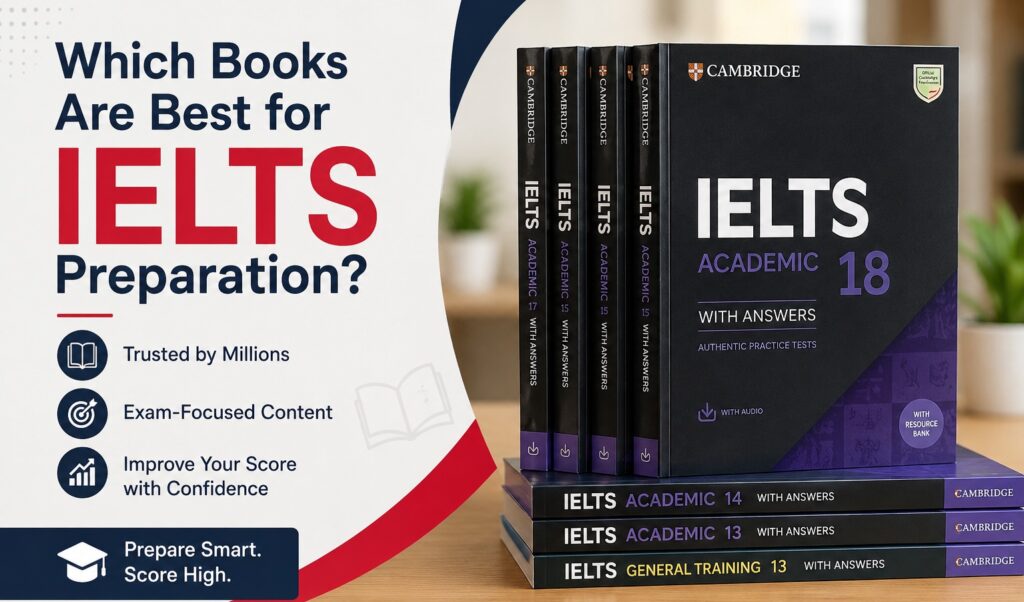
If you want the safest choice, Cambridge IELTS books remain the most reliable. These are widely trusted because they contain authentic past-test style practice and reflect the structure, level, and wording you are likely to face in the exam. They are especially useful for Listening and Reading because timing, question types, and answer patterns matter a great deal in those sections.
For students in Bangladesh preparing for UK, Canada, or Malaysia pathways, Cambridge books are often the best benchmark. They help you measure your real level instead of giving false confidence.
The best IELTS books by purpose
Best for realistic test practice
The Cambridge IELTS series is the closest thing to a standard recommendation. If your exam is in the next four to eight weeks, these books should be at the core of your routine. They are not ideal for teaching basic English from zero, but they are excellent for learning the exam.
What makes them useful is their realism. You see the actual style of instructions, the pressure of timed sections, and the difference between getting an answer nearly right and completely right. That distinction is important in IELTS.
If your level is already around intermediate or above, begin here. If your English foundation is weak, use Cambridge books alongside more supportive material rather than on their own.
Best for step-by-step strategy
The Official Cambridge Guide to IELTS is one of the better all-round books for students who want explanations, not just tests. It suits learners who keep asking, “Why did I lose marks here?” or “How should I approach this task?”
This book is particularly helpful because it combines skill-building with exam training. It can support both Academic and General Training candidates, although you should still check that you are focusing on the right modules for your exam type.
For self-study students, this is often a better first purchase than buying several practice-only books. It gives structure, which many learners need.
Best for writing improvement
Writing is where many candidates struggle, especially those targeting Band 6.5 to 7.5. A good writing book should do more than provide model answers. It should explain task response, organisation, vocabulary control, and grammar accuracy.
Barron’s Writing for the IELTS can be useful for guided writing practice, especially if you need a clearer sense of essay structure. However, any writing book has limits. If you copy model essays without understanding how they are built, your progress will be slow.
Books can teach formats and language patterns, but feedback is still essential. Writing is one part of IELTS where teacher correction often makes the biggest difference.
Best for vocabulary building
English Vocabulary in Use is a strong choice for students who need better range and accuracy in everyday and academic vocabulary. It is not an IELTS-specific book in the strictest sense, but that can actually be an advantage. It builds usable language rather than memorised test phrases.
For IELTS, vocabulary matters most when it is natural. Examiners are not looking for difficult words placed randomly. They want precise language used correctly.
Vocabulary books work best when paired with active practice. Learn a set of words, then use them in speaking answers and writing tasks. Without that second step, retention is weak.
Best for grammar support
Grammar for IELTS is a practical option for learners who keep making sentence-level mistakes. This book can help with common issues such as tenses, articles, prepositions, conditionals, and sentence variety.
Grammar support matters more than many students realise. In both Writing and Speaking, grammar affects your score directly. In Reading and Listening, weak grammar can also lead to misunderstanding the question or the answer.
Still, grammar books are not magic. If your errors are frequent and basic, you may need more guided teaching rather than independent study alone.
How to choose the right IELTS book for your level
A Band 5 student and a Band 7 student should not prepare in the same way. That is where many candidates lose time.
If your English is still developing, choose books with explanations, examples, and gradual practice. Start with a guidebook and a grammar support book. If you jump straight into advanced test papers, you may feel discouraged and fail to understand why your answers are wrong.
If you are already scoring near your target band, shift towards timed practice and review. At that stage, official practice materials matter more than general language-building books. You do not need ten resources. You need consistent, exam-focused repetition.
If you are preparing while studying at university or managing a job, simpler is usually better. A realistic plan with two or three strong books is far more effective than an ambitious plan with eight books you never finish.
Books that are useful, but not for everyone
Some IELTS books become popular because they promise fast results. Be careful with those. A book may still be useful, but only in the right context.
Band-score guarantee books can be motivational, yet they often oversimplify the exam. They may help with confidence and quick tactics, but they should not replace official practice. Likewise, books full of memorised speaking answers or writing templates can be risky. Examiners can usually recognise unnatural language.
There is also a trade-off with older editions. Some older books still offer good practice, but recent materials are usually better for matching current test style and expectations. If you have a limited budget, older books are not useless. Just do not rely on them alone.
A practical book combination that works
If you want a reliable study set, a smart combination is the Official Cambridge Guide to IELTS, one or two recent Cambridge IELTS practice books, and either English Vocabulary in Use or Grammar for IELTS depending on your weakness.
That mix covers method, realistic exam exposure, and language improvement. It also suits most Academic candidates and many General Training candidates, with some adjustment.
Students targeting higher bands should add regular review of mistakes. The book itself does not improve your score. Your analysis does. When you miss an answer in Reading, ask whether the problem was vocabulary, speed, concentration, or misunderstanding the question type. When your writing score stays flat, identify whether the issue is ideas, coherence, or grammar control.
That is why guided preparation often produces better results than self-study alone. At NextStep, students usually progress faster when expert feedback is combined with the right books, structured lessons, and regular mock tests.
Which books are best for IELTS preparation if you study alone?
If you are preparing independently, choose books that explain as well as test. Practice-only books are valuable, but they can leave self-study learners stuck.
A good self-study path is to begin with the Official Cambridge Guide to IELTS, then move into recent Cambridge IELTS books for timed practice. If writing is your weak area, add a writing-focused book and get your work checked whenever possible. If speaking is the issue, books help less than live practice, so make sure you speak regularly and record your answers.
Self-study works best for disciplined learners who can keep a schedule, review mistakes honestly, and avoid skipping difficult sections. If that does not sound like you, a coached programme may save time and reduce frustration.
What matters more than the book itself
Students often search for the perfect IELTS book, but score improvement usually comes from using a good book properly. One candidate completes four full tests, reviews every error, rewrites weak essays, and practises speaking daily. Another buys the same book and only reads model answers. Their results will not be the same.
A book should give you direction. Your progress comes from routine, correction, and smart practice under timed conditions. Choose trusted materials, keep your resource list tight, and focus on quality over quantity.
If your goal is a score that opens the door to university admission, visa processing, or overseas work, prepare with materials that reflect the real exam and support your actual weaknesses. The best book is the one that moves you forward clearly, week by week, towards the band score you need.
Frequently Asked Questions
Beginners usually benefit most from books that explain the exam clearly rather than only providing practice tests. The Official Cambridge Guide to IELTS is one of the best starting points because it combines strategy, skill-building, and realistic practice. Students with weaker English foundations should also consider structured support through an IELTS Foundation Course in Bangladesh before moving into advanced test practice.
Cambridge IELTS books are excellent for realistic test practice and understanding the actual exam format. However, many students still need additional support for Writing, Speaking, grammar, or vocabulary improvement. For higher band scores, combining Cambridge books with expert feedback often produces better results.
For Writing preparation, many students use Barron’s Writing for the IELTS alongside official Cambridge materials. A strong writing book should help with essay structure, task response, coherence, grammar accuracy, and vocabulary use. Still, personalised correction and feedback remain essential for improving Writing scores consistently.
Most students do better with two or three high-quality IELTS books rather than collecting too many resources. A practical combination usually includes one official practice book, one strategy guide, and either a grammar or vocabulary support book depending on your weaknesses.
Self-study can work well for disciplined learners who already have a reasonable English foundation. However, students often struggle to identify their mistakes in Writing and Speaking without expert feedback. Combining self-study with mock tests, correction, and guided lessons usually helps students improve faster and avoid repeated errors.
Students targeting Band 7 often rely on recent Cambridge IELTS books, The Official Cambridge Guide to IELTS, and focused grammar or vocabulary support materials. Reaching Band 7 usually depends more on consistent timed practice, error analysis, and regular Speaking and Writing feedback than on using a single “perfect” book.
Newer Cambridge IELTS books are generally better because they reflect current exam trends and question styles more accurately. Older editions can still be useful for additional practice, especially if you are on a budget, but recent versions should be prioritised for realistic preparation.
Yes. Listening and Speaking sections are similar for both exam types, but Reading and Writing tasks differ between Academic and General Training IELTS. Always make sure the books and practice tests you choose match the version of IELTS you plan to take.
Vocabulary books can help improve IELTS Speaking when new words are actively used in conversation and practice answers. Memorising difficult vocabulary without understanding how to use it naturally can sound unnatural during the exam. Regular speaking practice is still essential for fluency and confidence.
A strong self-study combination includes The Official Cambridge Guide to IELTS, one or two recent Cambridge IELTS practice books, and either English Vocabulary in Use or Grammar for IELTS. Students preparing online may also benefit from a structured online IELTS course that combines lessons, mock tests, and instructor feedback.
Students who prefer face-to-face learning, classroom interaction, and scheduled practice sessions often progress faster in structured coaching programmes. A professional IELTS coaching course in Dhaka can provide guided preparation, Writing correction, Speaking practice, and regular mock tests under experienced instructors.
Students based in the UK who want in-person IELTS preparation can explore this IELTS course in London. It is suitable for learners preparing for university admission, work, migration, or professional registration requirements.
Yes. Many students struggle in IELTS because their overall English foundation is weak rather than because they do not understand the exam format. Improving grammar, vocabulary, speaking confidence, and reading comprehension through a structured B2 English course in East London can strengthen overall IELTS performance significantly.